
by Jamie Krapf
Everyone has likely heard of a pyramid scheme before, or in recent memory maybe heard the word “Ponzi Scheme.” These are terms that sadly have stayed more than their fair share in the public consciousness. Contrary to popular belief, these are not the same thing—but rather similar. I’ll be breaking down the differences, similarities, and real world examples of these schemes. This is in mutual parts to educate you, the reader, to assist in avoiding these schemes, and what they are in earnest. I’ll make it clear now: these are both scams. Despite what some people may try to sell you, these are fraudulent and illegal. They are reliant on enriching the few, and robbing the rest. It is technically possible to make a profit in a ponzi scheme and pyramid scheme, as you’ll soon see—but in 99% of cases you will lose money.
Pyramid Scheme
Many people have fallen for, and will continue to fall for, pyramid schemes. It’s nothing to be ashamed of, as many organizations hide the scheme’s underpinnings with misleading language and subterfuge. In a pyramid scheme there is almost never any actual product being bought or sold. It generally revolves around recruitment, and selling people on joining you. This allows you to join this group, club, organization, or whatever they call themselves, which then allows you to sell access into the organization.
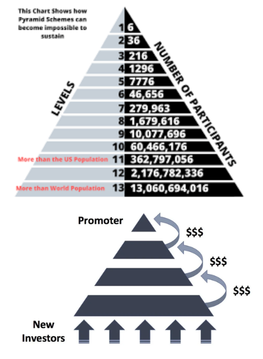
This all starts off very small, but grows exponentially. For example, one person sells a $100 membership to twelve people with the promise that they can sell this membership to others. Those twelve people then each sell to twelve more people per person up to 144 new people in the scheme. The now newly recruited 144 have to continue this chain in order to make their money back from this process. This continues ad infinitum until there aren’t any more people to buy the scheme. Say this continued for a while: assuming everyone recruits 12, the 144 grows to 1728, 1728 grows to 20,736, 20,736 grows to 248,832, and suddenly no one else wants to buy into your membership. About 248,832 people are out of one hundred dollars, and only a fraction of the people before them made their money back. Smaller still is the proportion of original sellers who actually made money. This is a very destructive process in which only a select few who got in early are able to make money at the detriment of others.
So how do people fall for this? If you knew this going into it, almost no one would bite at an opportunity almost guaranteed to lose them money. The sellers tend to use a lot of psychologically manipulative methods and social pressure. They say things like “you get to be your own boss,” “we aren’t selling a product, we’re selling an experience,” or “you have the opportunity to make tons of money with no risk.” Oftentimes, they try to shoot for scarcity, trust, or lifestyle marketing, saying there’s a limited number of spots left, advertising to a specific group of people they trust, like friends or coworkers, or using their fancy car to show you how well off you could be.
Ponzi Scheme
This is something much less complex, but much easier to fall for. Ponzi schemes are similar to pyramid schemes in the sense that they have almost no, or a severely overblown, product. A ponzi scheme is a simple concept. Engage in this hypothetical with me for a moment. Pretend you want to make money quickly and fraudulently. So you, as the perpetrator, promise potential investors that you have an amazing product, research, investing strategy, cryptocurrency, or really anything they can invest in. They invest money with you, and you charge a small fee for doing so. While you have their money, you say that you’re growing a lot.
Your promised product is making you so much money—however much money you want to tell them. People tell their friends, and invest more money into you. Some people take their money out, but most leave it in because you tell them it’s growing. The secret to this is, you don’t have a product at all. You’re just holding the money or putting it somewhere else. You’re lying about the returns or how much money is being made, all while charging small fees on people investing into you. This theoretically works great, as people almost never take all their investments out at one time. If someone does want to withdraw their investment, you’re holding enough money to pay them out due to how much money you’re “holding” from the other investors.
However, this all is contingent on two things: 1) you keep growing and attracting new investors to pay the old investors out, and 2) there cannot be a recession. To the first point, as long as you keep growing, and keep attracting new investors, you can lie to the old investors and tell them their investments are growing. As long as new people invest, you have seemingly infinite cash on hand. If you stop growing eventually your new investors will become old investors. Suddenly, you have no new money coming, and people are asking for more money than you have due to lying to them about the growth. If there is a recession, everyone will become very scared. As a byproduct of this, during a recession, everyone takes their money out of investments because they have less overall money. If all of your investors suddenly decide they want their money, you will not have enough money to begin to pay everyone back.
Much like pyramid schemes, this is a process in which most don’t make money, but a few can. If you invest early enough, and pull your money out in time, you can make money. However, this is gambling in its purest form: lose it all or make a small marginal profit on your money. How do people fall for this? It’s simple: ponzi schemes hide themselves as actual businesses. They can pretend to sell a product, be doing research, or be investing in a super secret way. If you aren’t the most financially literate, or you trust the wrong people with your money, it’s gone. You aren’t buying a membership and trying to recruit people like a pyramid scheme, you’re technically investing.
Despite this, there are some very clear alarm bells you can find from the get-go if you know what to look for. Ponzi schemes promise impossible returns, like 20-100% returns. They’ll offer little to no risk; oftentimes they won’t reveal what they’re investing in, or they will make it overly complicated. They prey on people’s sense of greed, and lack of investment knowledge.
The Takeaway
Ponzi and Pyramid schemes are especially cruel. They prey on people’s desperation and desire to get guaranteed money. Those who perpetuate these schemes lie directly to peoples’ faces in order to make a quick profit for themselves.
I nearly found myself wrapped up in a pyramid scheme when searching for a summer job. It was an online posting on LinkedIn—something that promised to be online, pay well, and give you your own hours. From the get-go, the position was rather vague on what you’d actually do for work. I was on a Zoom call with maybe 30 other people listening to the presenter. While there was no mention of what the actual work would be, there was a large emphasis placed on the amount of money you’d be making. The presenter made sure to include their shelves in the background showcasing statues, rings, and an excess of watches. It of course sounded extremely suspicious; my internal alarm bells rang loudly and constantly. The job market being as it is, however, I still continued to the one-on-one interview section. Before I could even get my name in to the interviewer, I was prompted to purchase a $75 “training course”. This was the final nail in the coffin for me, and I ended the call there. I suspect that several people who stuck through the strange interview did not make the same decision as me. As a lot of these “practices” can spring up like weeds, please take care as to whom you give your money to. If they promise anything above 10% returns, be suspicious, and if someone really wants you to commit to a $70 club, think thrice.