
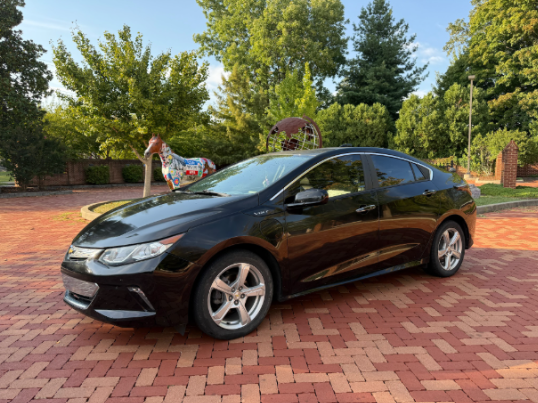
2017 Chevrolet Volt, owned by McKenzie Gatica
Want to see your ride featured? Feel free to submit it by contacting connor.parks@centre.edu
by Connor Parks
Well, folks, this is it. The lobbyists and politicians got me. Yep, you saw it right: the Cento is reviewing electric cars now, and there’s nothing I can do about it. Doesn’t matter that this thing is actually a hybrid, and only has about 50 miles of electric battery range, and gets around 53 miles per gallon average, and…well, maybe this won’t be too bad after all?
Before I even got the chance to drive this second generation Chevy Volt, there was just one word I would use to describe everything I thought I knew about it: improvement. Compared to the shaky electric attempt that was the first generation, the second-gen was lighter, quicker, had a significantly improved electric range, and looked much better in just about every way (look up the first gen and you’ll almost certainly agree). McKenzie’s owned the car, “Bean”, for a little under a year now after a tragic fate befell her previous Chevrolet Cruze and she took it over from her brother. In her eyes, it’s a comfortable, fitting replacement with just a few changes to the ownership experience (namely the electricity). And I’d entirely agree: it’s everything you’d want out of a standard, cute little economy sedan, only with the added touch of a little electric vehicle (EV) range, just a few years before the world bet big on an EV boom that, as we’re now seeing, was catastrophically overestimated. Volt production ended in 2019 as it couldn’t face the pressure posed by competition such as the Toyota Prius, yet I found it a compelling product for a number of reasons nonetheless.
Up front, the Volt’s features felt largely standard for an economy model of its time, with some slight bonuses that gave it an unexpected little dash of luxury. The seats were plush pleather, and made it ride higher than other cars in the segment. The steering wheel, fitted with plenty of intuitive controls for voice commands, controlling audio, and more, also had the option to be heated! This is easily the cheapest car I’ve seen with this feature (which can be very handy when needed), and I’m surprised to applaud Chevy on its inclusion. Most everything, aside from the seats, was electronically controlled (notably the mirrors and climate options), and it felt good to be able to use real knobs and dials instead of the touchscreens which have pervaded more modern cars. There are plenty of charming little electricky gimmicks too: a futuristic startup noise to alert that the car is on when there’s no engine running, a bright blue shift knob with little lightning bolts, and more to remind you of that invaluable 50 miles of electric range. And while that may not sound like anything, Kia recently cited a statistic of only 37 miles per day driven by the average EV/hybrid driver, meaning that a daily charge could ensure the gas engine would only be used on longer trips. With the previously mentioned whopping 53 mpg. average McKenzie gets with the car, and a 300 mile average range with the gas and electric motors, it’s no wonder she can count on one hand the amount of fuel-ups she’s done since returning from being abroad in the spring. Even with a 4-hour charge time at local chargepoints, and an 8 hour average with her smaller charger at home, it seems a small price to pay for a cheap and reliable ownership experience in the current economic state.
Other features were also better than expected for the time, namely the solid, easy-to-use Chevy Mylink infotainment system that rivals higher-end cars I’ve driven from around the same time. Everything from Apple Carplay pairing to checking tire pressure and fuel economy in the gauge cluster was seamless and intuitive. Space is a major plus as well: the front is slightly cramped, but the center console is deep and extends all the way to the cavernous rear seats. The Volt has easily the most rear space I’ve encountered in a car this size, and although the extended center console (with cupholders and a charging port!) eliminates the possibility of a middle rear seat, it’s a small price to pay for the immense legroom and ample headroom you get in the back. It’s also a hatchback, something I didn’t realise before this review, and an equally spacious one at that. With the rear seats all the way down, McKenzie and her mom were able to fit five wooden chairs in the hatch over the summer, and “easily could’ve stuck another one in there”. There’s no sunroof, but the extended hatch window makes up for it by stretching past the heads of rear passengers, and the standard trunk lights accompany an emergency kit, cargo strap holders, and a jack in the car’s remarkably ample furnishings. The rear EV battery, also accessible from the trunk, recently went out on McKenzie’s example after 9 years and cost around $300 to replace. While that may be more expensive than your ordinary car, it evens out when considering both the incredible fuel economy and the fact that the easy-to-operate charging port works with most any public charger out there: minus those pesky Tesla ones, of course.
Out on the open road, the Volt didn’t do much to impress, which didn’t surprise or underwhelm me at all: it’s a car of utility and value, not power. The rip-roaring 101 horsepower 1.5 litre inline 4-cylinder engine is backed by 181 extra horsepower through the electric motors, providing a blissfully quiet ride that’s modestly quick when accelerating with just the electric motor, but nowhere near breakneck speed. Switching from electric to gas and between the 3 drive modes– normal, sport, and mountain (?)– is fairly uneventful, although McKenzie said she feels the gas motor kick on with a slight jolt most of the time. Handling was above average, and it takes corners easily and deftly in both normal and sport. My only real complaint about the driving experience was with the braking: the car sometimes shifts back to the electric motor when decelerating, reducing the braking firmness a bit and forcing you to press down harder a second time before stopping. Aside from this, though, it felt equal to anything else in the segment unless I chose to keep the EV motor on when accelerating down straight stretches of road, in which case it proved easy to get carried away with speed at times.
All things considered, is the second-generation Chevy Volt the improvement I expected? Yes, and then some. For those looking for a cheap, reliable hybrid for their next (or first) vehicle, it’s quickly becoming an excellent place to start. One of the car’s greatest woes while in production was its steep price when compared to non-hybrid economy sedans, yet solid examples are now reliably selling around the $11-13,000 mark– a bargain compared to most other hybrids. Its styling is also a major plus– the lines are clean, sharp, and do just enough to distinguish the car as exactly what it aspires to be: a basic economy sedan plus a little extra zap. Considering a Civic, Corolla, Elantra, or something similar in this economy? Might I recommend throwing a Volt into the mix: it very well may shock you.