
by Duffy Oakley
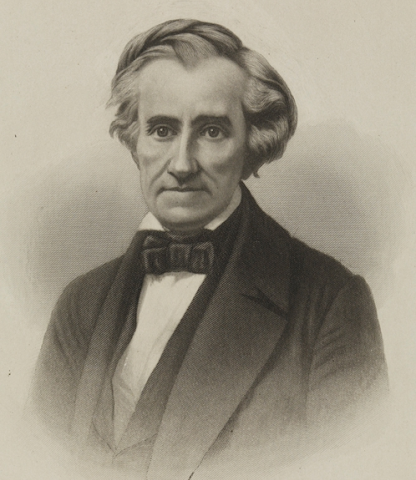
One of the most well-known former presidents of Centre College is John C. Young. According to Centre mythology, he was such a pivotal president in the formative years of the college that it was said that “John C. Young is Centre College and Centre College is John C. Young.” He is also one of our most honored former presidents, with his name even gracing an academic building (Young Hall, jointly named for him and his son, another former Centre President, William C. Young). Centre’s foremost student research program, the John C. Young Scholars program, is also named after him, with its annual symposium held each April. An eerie portrait of him even hangs in that random nook of his namesake building, so he is objectively the least “faceless” of all the names attached to Centre buildings.
Oh, and one other thing. If you’ve been following this series in the Cento, you have probably come to expect that he was a slaveowner.
Unlike Ephraim McDowell, John Marshall Harlan, and Robert J. Breckinridge, John C. Young was not born in the South or into a slaveowning family. In fact, he was born in Pennsylvania, where slavery had been legally abolished two decades before his 1803 birth. He only became a slaveowner after moving to Kentucky and marrying into prominent local slaveowning families.
Like Breckinridge, Young was also a proponent of “gradual emancipation” and the American Colonization Society. He opposed demands for the immediate abolition of slavery, including those made by Centre trustee James G. Birney and Centre professor James M. Buchanan when those two men cofounded the Kentucky Anti-Slavery Society in Danville in 1835. Instead, he envisioned a long process that would eventually lead to freed slaves being removed from the country altogether and sent to colonize Liberia. Proponents of gradual emancipation and colonization generally thought that free Black people would be a threat to the white social order and wanted to make the United States the exclusive domain of white people. They were not really interested in the freedom of Black people but rather in maintaining the stability and longevity of white supremacy.
Young’s biographies show that he freed some of his slaves on two separate occasions, although the Centre website’s blurb on the history of Young Hall misleadingly implies that he freed all of the slaves he received through marriage. Census records show that in 1850, the last census before his death in 1857, Young still owned four slaves, including two children. One of those children was categorized as mixed race, likely born through the rape of an enslaved woman, although it appears the boy came into the Young household sometime after his birth, as he was listed as 12 years old in 1850 but is absent from Young’s entry in the 1840 census. The three other enslaved people Young owned in 1850 were all categorized as Black: a 35-year-old woman, a 50-year-old man and a 16-year-old girl, although their names or possible familial relationship to each other were not recorded in the census.
Although Young supported the education of enslaved people in theory, especially in order to prepare them for colonization in Liberia, he did not embrace the education of Black people in practice. In 1835, under his presidency, Centre College rejected the application of James M. Priest, who had been born into slavery in Central Kentucky but educated and ultimately freed by his owner. Priest had joined the Presbyterian Church while enslaved and was placed under the direction of a local Presbyterian minister to prepare him for entering the ministry himself. Despite John C. Young’s stated belief that Centre should cultivate future Christian ministers for lives of leadership and service, Priest was not allowed to attend the college.
An 1837 article in the New York-based Black abolitionist newspaper The Colored American, which circulated widely in free Black communities in the North, called out Centre for closing the doors against Priest. The article chillingly asked: “For such treatment of the poor, can this College expect to escape the visitation of His displeasure who is the friend, the Almighty friend of the poor?” Priest would instead enroll in a theological seminary in New Albany, Indiana. Upon graduating, he served as a missionary in Liberia, where he was later elected Vice President and Associate Justice of the Supreme Court. Despite Young’s supposed support for the colonization of Liberia by freed slaves, he was not willing to actually support the education of its future leaders at his own college.
It is surprising (or is it?) that someone who so clearly failed to live out his values in practice is the person that Centre has chosen to commemorate not only with the name of an academic building but as the namesake of its most prestigious student research program. According to this college, the best model of scholarship that history has given us is a man who betrayed his own professed values by owning slaves and refusing to admit Black students to this college, let alone actually see them as equals. Echoing The Colored American’s haunting rhetorical question from 1837, we should ask ourselves: Is this really the message we want to send as a college? Is this slaveowner really who we should be honoring and modeling ourselves after as a campus community?