
by Oliver Longenecker
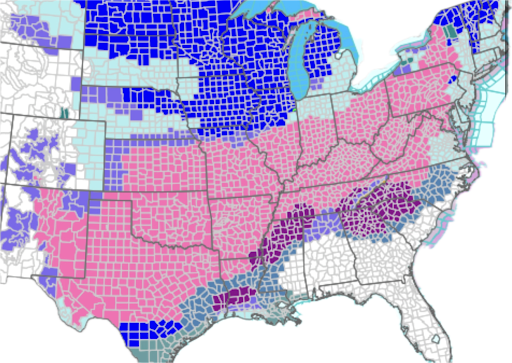
During the week of January 10-17th, 2026, the National Weather Service (NWS), Storm Prediction Center (SPC), and meteorologists began seeing a signal for a large, dangerous, and impactful winter storm for a large portion of the Central and Eastern U.S for period of January 22-25th. On Thursday, January 22nd, the SPC issued the first wave of winter storm warnings, for Central Oklahoma and North-Central Texas. In addition, they issued winter storm watches for the following States: Texas, Oklahoma, Kansas, Louisiana, Arkansas, Missouri, Mississippi, Alabama, Georgia, Tennessee, Kentucky, Illinois, Indiana, Ohio, the Carolinas, the Virginias, and the Northeast. The next day, Friday, January 23, the day before the main event, the SPC issued winter storm and ice storm warnings for those areas under the watch.
On the day of the event, models began to show a major shift in the severity of the ice portion of the storm. Initial model runs predicted the ice impacts to be substantial across Arkansas, Tennessee, and the Deep South. However, that shift began to move slowly North. For Boyle County, it was originally predicted that we would receive upwards of 8-12 inches of snow. Due to that last minute shift in the models, that heavy snow would now impact Indiana, Illinois, and Ohio, while ice accumulations would impact Kenucky. By the end of the day on Saturday, January 24th, we saw snow accumulations of around 4-5 inches, however during the early morning hours on the 25th, Sunday, icing started to become a major threat. By the late morning, roadways, sidewalks, steps, and other surfaces were coated in about 0.25-1 inch of ice, in addition to the snow.
With the worst of the storm having passed, students who planned to leave for the week break following the end of CentreTerm, began to get worried that they wouldn’t be able to leave campus. Campus maintenance immediately began the operation to clear the ice from sidewalks that day. However, due to the extreme freezing temperatures, and additional snow flurries the following days, Centre administration made the decision to follow “Plan C,” which saw all classes go virtual for the last two remaining days of CentreTerm, this included a “Final” day.
Conditions across campus became extremely dangerous, with an inch of ice plus snow on the sidewalks, parking lots, and outdoor areas. On YikYak, reports of students falling and slipping on ice became a major topic. There were a few reports of students getting injured, hurt, and concussions from falling. In addition to that, students couldn’t leave campus due to vehicles being stuck in the snow and ice.
With CentreTerm having come to an end, and the break beginning, the snow and ice still remained, and it would remain for up to two weeks. Almost two weeks after the event, and shortly after the start of Springterm, things began to heat up as warm, gulf moisture made its way into the Eastern U.S, bringing much warmer than average temperatures. Due to these warmer temperatures, the snow and ice finally began to melt. By Thursday, February 12th, the snow and ice was completely melted, the great winter storm of January 2026 was over.