by Duffy Oakley
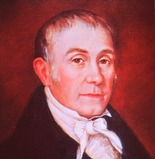
With the controversy around the newly installed John Marshall Harlan statue, it bears investigating the many other people commemorated on and around campus who have similarly contested legacies. In a series of Cento articles, I will strive to better inform the campus community about the figures who loom large at Centre and who they really were. I’ll begin with the man, the myth, the legend: Ephraim McDowell.
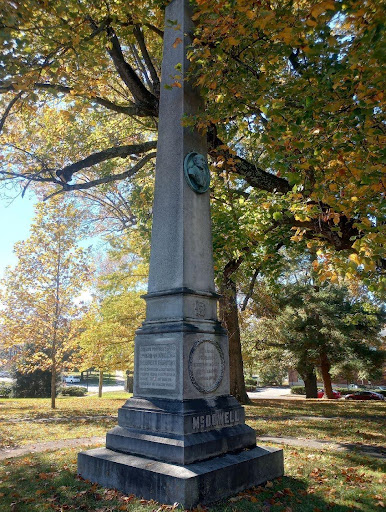
The name of Ephraim McDowell is omnipresent throughout Danville. In fact, the town is practically synonymous with the man. Ephraim McDowell Regional Medical Center, McDowell Manor, McDowell Park (between Centre and The Presbyterian Church of Danville, where there’s that big stone monument commemorating—who else—Ephraim McDowell), the McDowell House… the list goes on. But who was this man, and why does the whole town reflect his legacy?
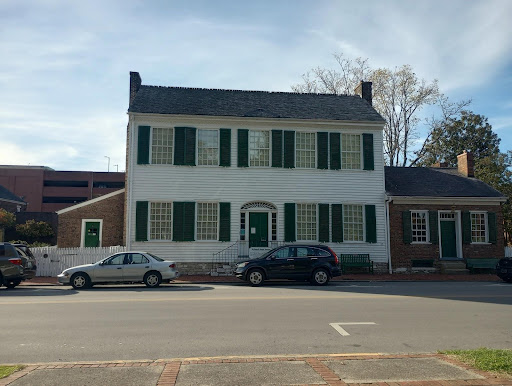
The story as it’s usually told is officially recounted by two state historical markers in town, one on Main Street across from Pearl Hall and the other outside the McDowell House on 2nd Street. On Christmas Day 1809, Ephraim McDowell, “the father of modern surgery,” miraculously performed the world’s first successful ovariotomy by removing a 22-pound ovarian tumor from Jane Todd Crawford. Adding to the mysticality of the legend is how Jane Crawford rode over 60 miles on horseback through the cold snow to get from her home in Green County to McDowell’s Danville medical office and, decades before anesthesia, “sang hymns” to get through the surgery. This is basically, with a few minor embellishments here and there, the same story that tour guides give in Frankfort—where Ephraim McDowell’s statue stands proudly in the capitol rotunda—and in Washington, D.C., where the same statue is one of two representing Kentucky in the National Statuary Hall (the other, if you’re wondering, is of Henry Clay, a 19th century plantation owner and politician from Lexington). In all of these sanitized accounts, McDowell is always portrayed positively as a mythic hero, a medical pioneer we should proudly remember and aspire towards.
The signs and tour guides don’t mention McDowell’s experiments on enslaved women.
In the same 1817 article in which McDowell first published his account of Jane Todd Crawford’s surgery, he also recorded two experiments he conducted on enslaved women brought to his office by their masters after the Crawford surgery. It is clear that, despite McDowell’s belief that these operations were inadvisable, it was their masters’ “earnest solicitation” and above all the fact that each woman was “unable to fulfill her duties” that justified medical intervention. In the first case, despite his belief that extracting the tumor would be “instantly fatal,” he continued on with the operation “by way of experiment” without any regard for the woman’s life or wellbeing, let alone consent. Despite McDowell thinking the case was “nearly hopeless,” she did in fact manage to survive the excruciating procedure in which her “bowels were completely enveloped” in “a quart or more of blood” that flooded her abdomen when McDowell cut into the tumor. He characterizes both of the enslaved women as happily returning to their forced labor “without complaint” after recovering from the experimental procedures on their bodies. He clearly saw these cases not merely as medical success stories but as successes in fulfilling their main objective, which was first and foremost to maintain the profitable exploitation of these women’s labor for the plantation economy of antebellum Kentucky.
Two years later, McDowell published another article describing three more experimental surgeries he conducted without consent on enslaved women. The first of these was one of the patients he had written about in 1817, who he thought had fully recovered, but whose tumor had regrown to the size it was when he first operated on it. A second one is said by McDowell to have “recovered happily” from the surgery but generally remained in poor health. He asserted that her “complaint is hysterical.” Two days after the third woman’s particularly gruesome surgery, she suffered “violent pain in the abdomen, together with an obstinate vomiting.” After being bled by McDowell without any lessening in her pain, she died on the third day after her surgery from an inflamed abdomen stemming from the operation.
Unlike Crawford, none of the four enslaved women’s names were recorded by McDowell. We know only that one of them came from Danville and two others came from neighboring Garrard and Lincoln counties. McDowell did not name where the fourth enslaved woman came from, only writing that she “was brought to [him] from a distance.”
It is also not known whether he performed experimental surgeries on other enslaved women. Although he published only five accounts of abdominal surgery, including Crawford and the four enslaved women, he boasted in a letter that he had performed a total of twelve, according to the Smithsonian. While the four documented surgeries on enslaved women all took place after Crawford’s, it is possible that McDowell had already “practiced” his surgical technique on enslaved women before Crawford’s surgery in 1809. If so, he likely made a deliberate choice to exclude these women from the historical medical record to instead frame Crawford’s almost-mythical surgery as the first of its kind.
The Smithsonian also quotes the assistant director of the McDowell House Museum saying that the history of these surgeries on enslaved women is not generally addressed in exhibitions or tours at the museum. Instead, it is up to individual tour guides whether they mention the history of slavery at McDowell’s residence, where between ten and fifteen slaves lived. Thus, visitors receive an inconsistent image of McDowell as a slaveowner who experimented on enslaved people.
Instead, McDowell is memorialized throughout town–as well as in both the state and federal capitols–as a mythic hero. The monument to him between Centre and the Presbyterian Church of Danville, erected by the Kentucky State Medical Society on the spot where he was reinterred in 1879, gives him the legendary moniker, “The Father of Ovariotomy.” Like at the McDowell House Museum, his public legacy is whitewashed to erase his participation in the institution of slavery and his excruciatingly painful experiments on enslaved women.
Commemorating McDowell and others in this way without the full context paints a particular historical narrative that erases the violent systems of white supremacy and patriarchy that allowed for their success. J. Marion Sims, a 19th century surgeon who followed in the footsteps of Ephraim McDowell and similarly experimented on enslaved women, was also long celebrated as the “Father of Gynecology” and publicly memorialized for his medical and scientific achievements. But in recent years, people have sought to acknowledge the full history of his work, which preyed on the unconsenting bodies of Black women for his own benefit. This has culminated in the removal of Sims’ statue from Central Park in New York City and the installation of new public sculptures remembering three of the women whose bodies Sims experimented on in Montgomery, Alabama, where the brutal experiments took place (near another statue of Sims that still stands in front of Alabama’s state capitol).
If we are serious about acknowledging the history of Ephraim McDowell and his legacy in Danville, Kentucky and the country, then we must tell the full story. We cannot continue remembering McDowell while constantly and intentionally forgetting the enslaved women who paid for his success with their own bodies. Even if they never get a statue or monument of their own–a monument they deserve just as much as McDowell–we must not ignore their presence. It is our duty to see them and honor them.